
You use an adapter coupler to connect cables or connectors. This helps different systems work together. These adapters are very important in many industries. Some examples are telecommunications, data centers, and industrial automation.
| Industry | Description |
|---|---|
| Telecommunications | Good light transfer and strong signals in communication systems. |
| Data Centers | Fast and safe data transfer between servers and devices. |
| Subsea Communications | Long-distance networks and better data speeds. |
| Financial Services | Keeping data private and safe from cyber threats. |
| Defense | Sending data in a safe and secure way. |
| Industrial Automation | Sending data reliably for factories and machines. |
There are new trends in adapter design. Some adapters are now modular and can be recycled. This is because people care more about the environment. The rise of IoT devices also drives these changes.
Adapter couplers join different systems. They help communication and data sharing. Many industries use them, like telecommunications and data centers.
Picking the right adapter is important. You should check insertion loss and return loss. This helps keep signals strong and connections working well.
Quick coupler adapters save time. They make things safer. You can connect and disconnect fast. You do not need tools. They work well for hydraulic systems.
There are many kinds of adapter coupler for cables. Each kind helps connect systems and makes work easier. The main types are fiber optic adapter coupler, quick coupler adapter, and adapters for pipes and Ethernet cables.
Fiber optic adapter coupler joins two fiber optic cables. It keeps the signal strong and the connection steady. You use it in data centers and telecom networks. These adapters are special because they line up cables very well. They also stop signals from getting weak. Here is a table that shows their features:
| Feature | Description |
|---|---|
| Precision Alignment | Lines up cable cores to lower signal loss. |
| Incompatibility | Connects different fiber connectors or same type from other cables. |
| Durability | Stays strong against damage and weather. |
| Low Signal Attenuation | Keeps signals strong between cables. |
| Reusability | Can be used many times without losing quality. |
SC and LC connectors are used with fiber optic adapter coupler. These connectors usually have insertion loss less than 0.5 dB.
| Connector Type | Typical Insertion Loss |
|---|---|
| SC Connector | Less than 0.5 dB |
| LC Connector | Less than 0.5 dB |
Quick coupler adapter lets you connect and disconnect hoses fast. You use it in factories, building sites, and farms. This adapter saves time and keeps machines working well. You do not need tools to use it. You just push and lock the hoses together.
There are adapter coupler for pipes and Ethernet cables too. Pipe adapters join pipes of different sizes or materials. Ethernet adapters connect network cables for computers and devices. New materials like ceramics and alloys make these adapters stronger. They can handle heat and tough places without breaking.
A fiber optic adapter coupler joins two fiber optic cables. This lets light signals move from one cable to another. The adapter lines up the cable cores. This helps the light pass through with little loss. You see these adapters in data centers and telecom rooms. Strong signals are important in these places.
Fiber optic adapters work with many connector types. Some common ones are LC, SC, and MPO connectors. Each connector has its own insertion loss and return loss. Insertion loss is how much signal drops when you connect cables. Return loss is how much signal bounces back instead of moving forward. Lower insertion loss and higher return loss mean better signals.
Here is a table that shows typical values for different connectors:
| Connector Types | Fiber Type | Recommended Maximum Insertion Loss (IL) |
|---|---|---|
| LC Connector | Single-mode | ≤0.4 dB |
| LC Connector | Multimode | ≤0.3 dB |
| SC Connector | Single-mode | ≤0.5 dB |
| SC Connector | Multimode | ≤0.4 dB |
| MPO Connector | Single-mode | ≤0.75 dB |
| MPO Connector | Multimode | ≤0.75 dB |
You also need to check the end-face type. PC, UPC, and APC end-faces have different return loss values. Here is a table for return loss:
| End-Face Type | Fiber Type | Recommended Minimum Return Loss (RL) |
|---|---|---|
| PC | Single-mode | ≥30 dB |
| PC | Multimode | ≥20 dB |
| UPC | Single-mode | ≥50 dB |
| UPC | Multimode | ≥25−30 dB |
| APC | Single-mode | ≥60 dB |
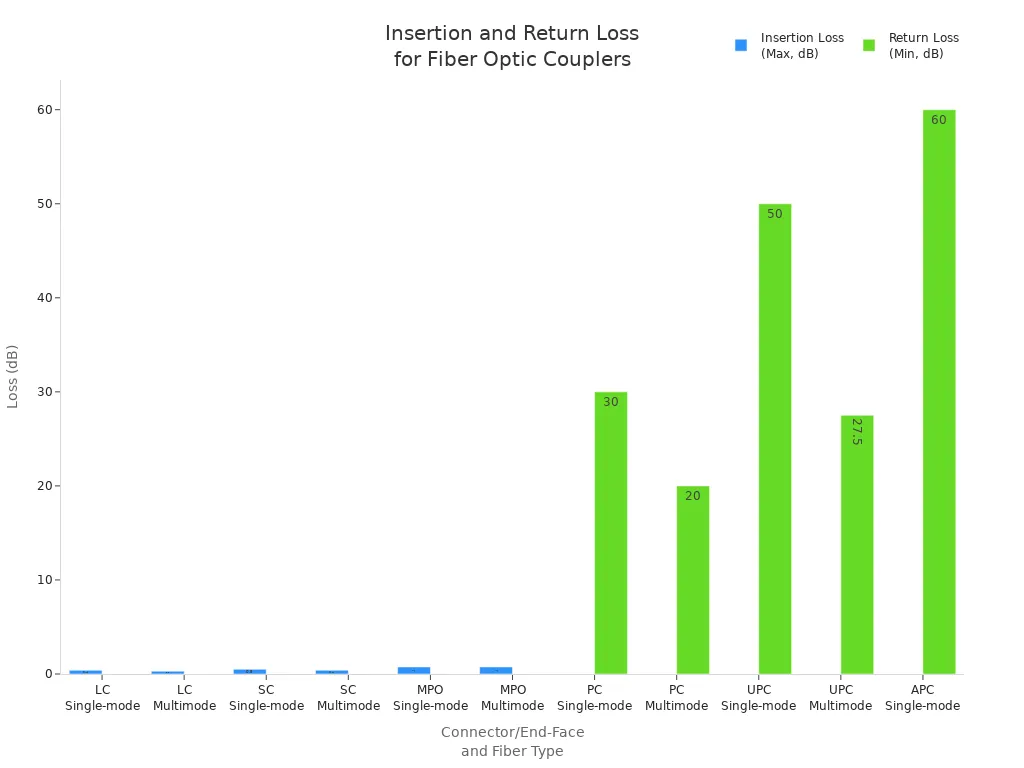
Tip: Always check insertion loss and return loss before picking an adapter. This helps your network stay fast and strong.
You use these adapters to link cables from different systems. For example, you might connect a single-mode cable to a multi-mode cable. This happens in telecom racks. The adapter keeps the signal strong. You can also join cables with different connectors, like LC to SC. This helps you build networks that can change and grow.
A quick coupler adapter lets you connect and disconnect hydraulic hoses fast. This saves time and keeps machines working. You see these adapters in factories, farms, and building sites. You do not need tools to use them. You just push the hose into the adapter and it locks.
Quick coupler adapters work in two main ways:
Flat Face Quick Couplers have flat surfaces that seal. These stop fluid from leaking when you take hoses apart. This keeps your work area clean and safe.
Poppet Quick Couplers have valves inside. These close when you disconnect the hose. They stop leaks, but sometimes a little fluid escapes.
Here is a list of how quick coupler adapters help you:
You connect and disconnect hydraulic lines fast.
You cut down on downtime and keep machines running.
You stop fluid loss and keep things clean.
You make repairs and changes easy.
Safety is important too. Hydraulic quick coupler adapters have locks. These locks keep hoses connected, even under pressure. Here is a table that shows common safety mechanisms:
| Safety Mechanism | Description |
|---|---|
| Secure Connections | Ensures couplers are fastened to prevent disconnection. |
| Locking Mechanisms | Built-in features that secure couplers against accidental disconnection. |
Note: Always check the lock before using a quick coupler adapter. This keeps you safe and stops accidents.
You use quick connect coupling and push to connect coupling in many machines. For example, you might need to change a hydraulic hose on a tractor. The quick coupler adapter lets you do this in seconds. You do not spill fluid or waste time.
You use adapter coupler in plumbing to join pipes of different sizes or materials. This helps you fix leaks or build new water lines. You see these adapters in homes and factories. You push the pipe into the adapter and it seals tight. This makes repairs fast and easy.
In networking, you use adapter coupler to join Ethernet cables. You connect computers, printers, and other devices. The adapter lines up the wires so data moves quickly. You might use an adapter to join a Cat5 cable to a Cat6 cable. This lets you upgrade your network without changing all the cables.
Here are some practical examples:
You fix a broken water pipe with a push to connect coupling. You do not need glue or tools.
You extend a network cable with an Ethernet adapter. You keep your devices online.
You join two hoses with a hose coupling in a garden or factory.
Callout: Always pick the right adapter for your job. The wrong adapter can cause leaks or slow down your network.
Many adapters are made from strong materials like ceramics and alloys. These adapters last longer and work in tough places. You use them in hot, wet, or dirty spots. This keeps your systems running.
Adapter coupler helps you connect different systems. You use them in fiber optics, hydraulics, plumbing, and networking. Each type works in its own way, but all make your work easier and faster.
You should pick the right adapter coupler for your work. Each kind is best for certain systems.
Use tough materials so adapters last longer.
Clean adapters often and check them for damage.
Choose designs that block dust, water, and shaking.
This helps your connections stay safe and work well.
You use a hydraulic adapter coupler to join hydraulic hoses and fittings. This lets hydraulic fluid move between machines.
Hydraulic quick coupler adapters lock fittings tight. This stops leaks and keeps pressure steady. You stay safe when you fix hydraulic systems.
You can join hydraulic adapter couplers to many fittings. You match thread types and sizes. This helps you connect hoses in different systems.
Tip: Always check if parts fit before using hydraulic adapter couplers. This stops leaks and keeps systems working well.
Hydraulic adapter couplers work with pumps, cylinders, and valves.
You use them in repair shops and factories.
Hydraulic adapter couplers help you change hoses and fittings fast.
You find them in tractors and excavators.
Hydraulic adapter couplers fit pipes and tubes.
You use them for oil transfer.
Hydraulic adapter couplers connect motors and actuators.
Hydraulic adapter couplers help control pressure.
You use them in testing.
Hydraulic adapter couplers join lines in construction.
Hydraulic adapter couplers work with seals and gaskets.
Hydraulic adapter couplers fit connectors and couplings.
You use them for fluid sampling.
Hydraulic adapter couplers help you make hoses longer.
Hydraulic adapter couplers help upgrade systems.
You use them for maintenance.
Hydraulic adapter couplers work with pumps and tanks.
Hydraulic adapter couplers join pipes in machines.
Hydraulic adapter couplers fit fittings for equipment.
Hydraulic adapter couplers connect hoses in vehicles.
You use them for troubleshooting.
Hydraulic adapter couplers help you swap fittings.
Hydraulic adapter couplers help fluid flow.
Hydraulic adapter couplers work with pressure gauges.
| Hydraulic Adapter Coupler Use | Hydraulic Fittings Needed | Hydraulic System Example |
|---|---|---|
| Join hoses | Yes | Excavator |
| Change lines | Yes | Tractor |
| Fix leaks | Yes | Pump station |


